

How Mr Spock changed my life
In the course of my journalism career I have had one editor call me “extremely well organised” and two others call me “disciplined”. This would come as a surprise to anyone who knew me during my childhood and adolescence. Back then I was an impetuous and emotional creature; I had a bad temper, took everything to heart and tended to do a lot of things I regretted later. But at about age 16, I watched my first episode of Star Trek (the original series) and it would alter my outlook on life.
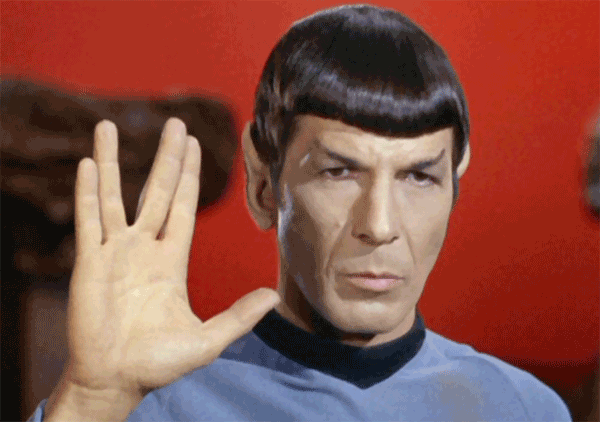
If I recall correctly, I knew about the concept of Mr Spock – a being of pure logic – beforehand and was intrigued enough to watch Star Trek as a result. It took some time to mentally accommodate the dodgy special effects and occasional bursts of over-acting, but once had, I discovered (as all who watch it do) that Star Trek had a lot going on. In those earliest days, however, it was Mr Spock who fascinated me.
Here was an individual who was never at the mercy of his emotions (well, most of the time, but that’s beside the point here). In him I saw my complete opposite. He never lost his temper, lashed out, cried, pitied himself. No matter how grave the situation, he approached it with a cool intellect and tried to solve it the way a mathematician solved a problem on a blackboard. I wondered if I could apply a similar approach to my own life.
Around this same period two other personal obsessions intersected with Spock. One was martial arts and the other was bodybuilding. Both these pursuits required a high degree of discipline, both mental and physical, and in concert with my ‘Spock’ way of thinking, they helped me become a different person. Not just figuratively, either – between the ages of ten and 15 I was overweight; over the summer of 1992-1993 I shed nearly 15 kilos. The change was so dramatic that one of my schoolmates remarked on it and I will never forget the exchange between us:
Daniel [looking me up and down]: “What happened to you?”
Me: [feigning ignorance but unable to quash a smile]: “What do you mean?”
Daniel: “Where’s the rest of you?”
With my life thusly improving I began to see unreined emotion as weakness. My guru in this respect was Arnold Schwarzenegger, who, when confronted with the notion that ruling one’s emotions was inhuman, responded that it was actually superhuman. Much like a certain Vulcan…
The man behind that Vulcan, of course, was the actor Leonard Nimoy. In 1995 I happened upon his new autobiography, I Am Spock, and it affected me almost as much as those first episodes of Star Trek had. I became invested in Nimoy’s life – his creative struggles on Trek, his subsequent career on the stage and in other TV shows, his eventual return to the Trek franchise as both actor and director, the double-edged sword of his success and celebrity. For me, he came to represent a lot of what was good about Hollywood. He could take a joke at his own expense – see his recurring roles in The Simpsons and Big Bang Theory – but he also took his role as Spock and the legacy of that seriously. He had integrity and he was a gentleman, which are two things not commonly associated with the TV and movie-making businesses.
Not often does the passing of a celebrity give me a pang of sorrow, so when it does it’s a bit like touching a fence you didn’t know was electrified. It happened when I learned the Pantera guitarist ‘Dimebag’ Darrell Abbott had been murdered. It happened when the cricket commentator Tony Greig died. And it happened when Leonard Nimoy passed on last month.
I suspected something was up when I read that Nimoy had been rushed to hospital with complications of lung disease. I know from events in my own life that a chronically ill person in his eighties who is taken to hospital rarely comes out again. So Nimoy’s death didn’t hit me with a hammer-strike of shock the way Dimebag’s did. I think I felt Greig’s death more keenly in the moment, too, because, it plucked a nostalgic chord in me; the man’s voice had been part of the soundtrack to every summer in my life since the late 1980s. What I felt on learning of Nimoy’s death was more like the melancholy one feels when a beautiful old building is torn down.
If somebody says, “I don’t read fiction,” I can never decide whether to feel sorry for that person or hold them in contempt. The same goes for those who watch the news and reality TV but never tune into a movie or a good quality drama. These people who shun imagination compile plenty of facts but no wisdom; they can name every intricate part in the machine of their existence but will never know how it works. Worst of all, they will never tap into the panoramic perspective that fiction (in whatever medium) brings. A good story is, among other things, a distillation of the human condition.
High flown stuff, but with a practical end in the real world. Because sometimes a story, or a character in that story, can change a real person’s life. I know, because a fictional alien known as Spock changed mine.


Comments